Home equity loan in NZ: top up, cash out and revolving credit explained
6 min read
What a home equity loan and a HELOC usually mean in New Zealand, mapped to a top up, cashing out equity and revolving credit on the home.
If you have been reading overseas sites, a home equity loan or a HELOC (home equity line of credit) can sound like a product you should be able to ask for by that name. New Zealand's public guides do not use those names. Borrowing against the equity in your home shows up as a top-up loan, as borrowing more when you refinance (often called cashing out), or as a revolving credit facility secured on the home. This page is only the map between the words. How a top up works in practice is in our home loan top up guide, and cashing out when the loan is replaced is in using your home equity.
Key points
- Home equity loan and HELOC are overseas names. The public guides here talk about a top up, cashing out equity, or revolving credit on the home.
- A top up adds to the loan you already have. Spreading that extra over the whole mortgage can raise the total you repay, even when the rate is lower than a shorter loan.
- Cashing out usually means borrowing more as part of replacing the loan, so you take a lump sum and the balance is larger.
- Revolving credit is a limit you can draw and repay, inside the terms of that facility, and it needs discipline.
- Lenders look at equity, LVR and the repayments. The Reserve Bank publishes the LVR settings, and each lender adds its own rules.
What do home equity loan and HELOC mean in NZ?
Overseas, a home equity loan usually means a lump sum borrowed against the equity in the home, and a HELOC means a limit you can draw, repay and draw again. The govt.nz page on borrowing against your home does not use either name. It describes a top-up loan as the common way to borrow against equity, and it lists a reverse mortgage separately as a later-life loan, which is not one of the three paths below. Sorted and Consumer Protection describe revolving credit as a mortgage structure, closer to a large overdraft secured on the home than to a product called HELOC.
Equity is the gap between what the home is worth and what you still owe. It is not money you can spend until a lender agrees to lend against it, and how much might be possible depends on that equity and on whether you can make the repayments. The cash out equity page is the longer look at using the gap, and the cash out equity calculator is a rough sketch of room under an LVR figure you choose.
How do a top up, cash out and revolving credit compare?
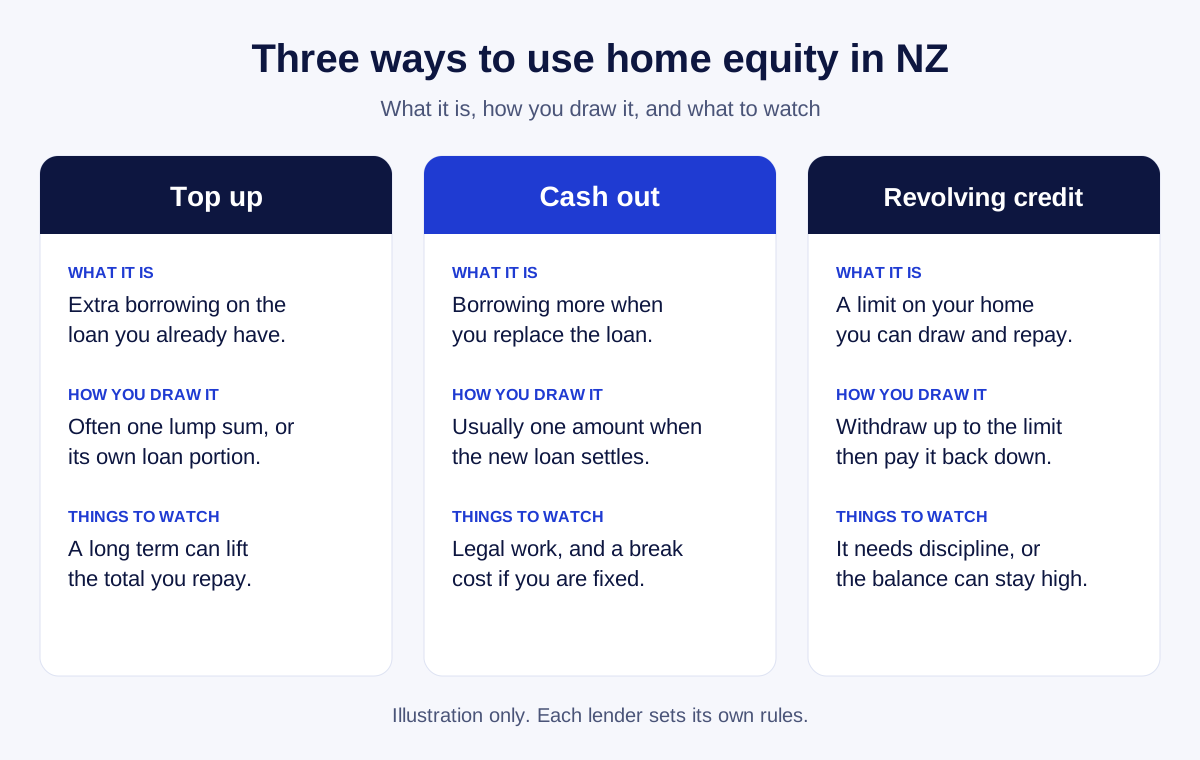
A top up is extra borrowing on the loan you already have, usually with your current lender. Govt.nz calls a top-up loan the most common way to use the equity in your house. The extra is new borrowing, so the lender looks at your situation again, and people often draw it as a lump sum or as its own portion of the loan.
Cashing out equity is the everyday name for taking money by borrowing more, often when the existing loan is replaced. Sorted describes refinancing as replacing your mortgage so you can get different terms or borrow more, and it lists a lump sum, including for renovations, among the reasons people do it. You usually draw one amount when the new loan settles. There is legal work to change the mortgage, and a break fee is possible if a fixed term still has time to run.
Revolving credit is a limit secured on the home. Sorted describes it as working like a large overdraft: you can pay money in, redraw up to the limit, and interest is worked out on the balance each day. Some facilities reduce the limit over time. You draw it by withdrawing when you need to, rather than taking one lump sum on day one, and Sorted notes that this stays inside the original terms and limit. That is a different conversation from asking the lender to lend more. Consumer Protection lists revolving credit next to a standard loan as a structure to choose.
How do lenders look at equity and LVR?
A lender is not lending against a figure you have guessed. It looks at a value it accepts for the property, at what you would owe once any new borrowing is included, and at whether the repayments are likely to be affordable. Under the responsible lending rules, the lender has to ask what the money is for, check that the loan suits that purpose, and check that you can likely make the payments without substantial hardship.
LVR is the loan compared with the property value the lender is using. The Reserve Bank sets speed limits on how much high-LVR new lending banks can do. A top-up that pushes the total loan over the threshold is treated as new lending under those settings, while a refinance that does not increase the loan can sit outside the speed limits. Banks still apply their own criteria, and they may only lend at a lower LVR than the published line. The settings move, so the current numbers belong on the Reserve Bank LVR page, not in an article that would go out of date.
What are the trade-offs in plain words?
A top up can fund a job or a one-off cost that savings will not cover, and the trade-off is the term. Sorted notes that extra borrowing secured on the home can cost more in total if it is spread across the whole mortgage, even where the rate is lower than a shorter loan, and that falling behind puts the home at risk. Paying the extra down faster, where the lender's terms allow it, keeps that total smaller. Rates change often, so check current rates rather than an old figure.
Revolving credit asks more of your day-to-day habits. Sorted's warning is that it requires discipline, because it is tempting to spend up to the limit and stay in debt longer, and that this kind of credit should not be used for ordinary spending. There is no set repayment forcing the balance down, unless the limit itself reduces. It can suit an uneven income, and keeping the balance low is what reduces the interest.
Cashing out as part of a refinance brings the costs of moving the loan into the same conversation. Sorted lists break fees if you leave a fixed term early, any cash incentive you might have to repay, discharge fees, solicitor fees, a valuation and application fees, and it notes that taking cash as part of a refinance can affect your credit history. Your quotes will not match someone else's, so that list is a prompt for what to ask.
Tip Write down what the money is for, and how you would pay the extra back, before you ask a lender or a broker for figures. A clear purpose is part of what the lender has to look at, and it keeps the conversation on your goal.
There's no credit check to enquire.
When is it worth talking it through with a broker?
It tends to be worth a conversation when the goal is clear and the path is not: stay with your lender and top up, refinance and take a lump sum, or set up a revolving limit you would actually pay down. A broker can talk through those options with your own statements. Consumer Protection says the same thing in its own words, that a lender or a broker can talk the structures through with you. We do not arrange the loan, and we do not choose the path for you. If you would like someone to get in touch, get in touch now.
Home equity loan FAQs
Is there a HELOC in New Zealand?
Not under that name in the public guides. The local version of a limit you can draw and repay, secured on your home, is a revolving credit facility. A lump sum against equity is usually a top up, or extra borrowing when you refinance.
Is a home equity loan the same as a top up?
For most people searching from New Zealand, a top up is the closest match to what overseas sites call a home equity loan: extra borrowing secured on the home, often taken as a lump sum. It is still new borrowing, and the lender looks at it again. Cashing out during a refinance is the other lump-sum path.
Does using equity always cost more over time?
It can. Extra borrowing spread over a long mortgage term can cost more in total than paying it off sooner, even at a lower rate than a short loan. Revolving credit can also stay costly if you keep drawing back up to the limit. The total depends on the balance, the term and the rate, and rates change often.
Can I use equity without refinancing to a new lender?
Often, yes. Borrowing more with the lender you already have is a top up, which is different from replacing the loan. A revolving credit limit can also sit with your current lender, inside the rules of that facility. Whether either is available depends on that lender's own criteria, including equity and whether the repayments fit.
Sources (checked 10 Nov 2026)
- New Zealand Government, Borrowing against the value of your home: equity is the difference between what the home is worth and what you owe, a top-up loan is described as the most common way to use that equity, and a reverse mortgage is listed separately.
- Sorted (Retirement Commission), Types of mortgages: revolving credit works like a large overdraft, you can redraw up to the limit, interest is calculated daily, some limits reduce over time, and it requires discipline.
- Sorted (Retirement Commission), Personal loans: a revolving credit home loan stays within its original terms and limit, extra borrowing secured on the home can cost more in total if it is spread over the whole mortgage, and falling behind puts the home at risk.
- Sorted (Retirement Commission), How to refinance your mortgage: refinancing replaces your mortgage so you can get different terms or borrow more, including a lump sum, and lists the costs to compare. Taking cash out can affect your credit history.
- Consumer Protection (MBIE), Mortgages and home loans: mortgage structures include revolving credit, and a lender or broker can talk the options through.
- Consumer Protection (MBIE), What lenders must do: lenders must check the loan suits what you need it for and that repayments are likely to be affordable.
- Reserve Bank of New Zealand, LVR restrictions: LVR speed limits apply to new lending, a top-up that crosses the threshold counts, a same-balance refinance can sit outside them, and banks may lend only at lower LVRs.
General information only, not advice. We're a referral service. Mortgage advisers are usually paid a commission by the lender. If your loan settles, the adviser's business may pay Online Home Loans a referral fee. It is not added to your loan and does not change what you pay.