Is refinancing worth it in NZ? A simple break-even check
(updated )7 min read
Whether refinancing is worth it in NZ depends on a simple break-even check. Add the one-off costs and see how many months the saving takes to cover them.
It can be, when the money you save on a lower rate covers the one-off costs of moving, and you keep the loan long enough for that to happen. A simple break-even check sets those costs against the monthly saving and turns the gap into a number of months. If you expect to stay longer than that, the move can come out ahead. If you might sell, or switch again, before then, the sharper rate may not pay for itself. The figures further down are a made-up example so you can see the method. They're not current rates, and they're not a quote for your loan. Rates change often, so check current rates before you decide anything from an old comparison.
Key points
- Refinancing is worth a closer look when the saving outlasts the costs. Divide the one-off costs by the monthly saving to see how many months you'd need to stay.
- Count every cost of moving, including a break fee if you're still fixed, legal fees, a valuation, discharge or application fees, and any cashback you'd have to pay back.
- A lower rate on its own isn't the whole answer. The saving can shrink when the new term ends, because rates change often.
- Your lender has the real break fee. Ask for it in writing for your loan and the date you have in mind.
What does a simple break-even check look at?
Sorted, the Retirement Commission's money guide, says the way to judge a refinance is to include all the costs and compare them with the benefit you expect. The simple version of that is three lines.
- Add up the one-off costs of switching.
- Estimate the monthly saving from the lower rate, using a repayment figure for your own balance and term.
- Divide the costs by that monthly saving. The result is roughly how many months it takes to come out ahead.
That sketch isn't a full interest calculation. It leaves out the way a lower rate also changes how quickly the balance falls, and it assumes the monthly gap stays put for those months. It's still a useful first filter before anyone spends time on a full application.
Which one-off costs usually belong in it?
These are the one-off costs Sorted lists for switching lenders. Your quotes will be different, and some of them may not apply to you at all.
- Break fee, if you leave a fixed term early. On a consumer home loan the fee has to be a reasonable estimate of the lender's loss, and the extra cost generally applies when market rates have fallen since you fixed. There's normally no break fee when the fixed term simply ends. Our guide to how mortgage break fees are worked out covers what to ask for.
- Legal fees. Moving lenders usually means a solicitor or conveyancer changes the mortgage. Ask for a written quote before you commit.
- Valuation. If you switch lenders, the new lender may want a valuation, and that can add cost and time. It's worth checking whether it's included before you count on it.
- Discharge and application fees. Your current lender may charge a fee to release the loan, and a new loan can have an application or establishment fee.
- Cashback you'd have to pay back. A cash incentive often has a period written into the contract, and if you leave inside that period the lender can ask for it back. Our checklist of refinance costs in NZ walks through clawback in more detail.
A cash contribution from the new lender can reduce the net cost, but only if you're comfortable staying for its own clawback period. It belongs in the same sum rather than being a reason on its own to move.
How does a worked example play out?
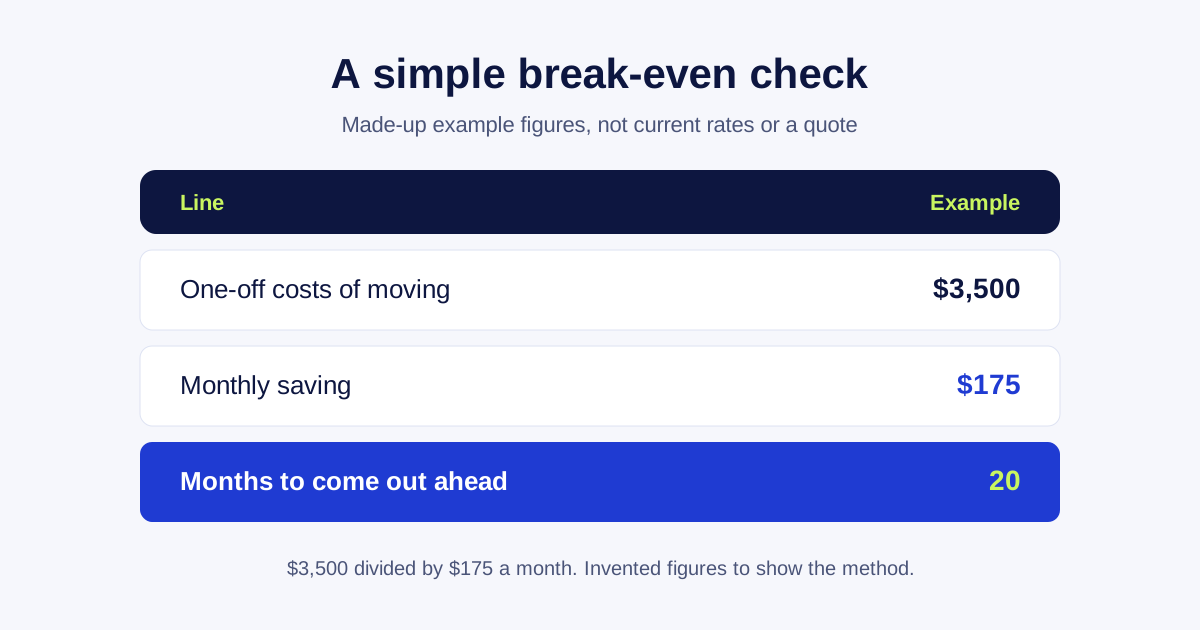
Suppose, purely as a made-up example, the costs of moving added up like this: a break fee of $1,200, legal fees of $1,100, a valuation of $600, a discharge fee of $150 and cashback to pay back of $450. That's $3,500 in one-off costs. Suppose the lower rate then reduced the repayment by $175 a month. Divide $3,500 by $175 and you get 20 months. In this example you'd need to keep the new loan for about 20 months before the saving had covered the cost of moving. None of those figures is a current rate, a typical fee or a quote. They're here so the arithmetic is easy to follow, and your own numbers will be different.
Tip Ask your lender to email a break fee quote for your loan and the exact date you're thinking of, then put that number in the top line. An old quote, or a mate's, won't tell you whether your own move stacks up.
There's no credit check to enquire.
How many months does it take to come out ahead?
There's no single number of months, because the result moves with your balance, your costs and the size of the rate gap. A small monthly saving takes longer to cover the same bill. A large break fee can push the point where you come out ahead past the time you plan to stay. If the fixed term is about to end and there's no break fee, the top line is smaller and the months shrink, so the end of a fixed term can be a simpler point to run the check.
Once you have your own quotes, the refix vs refinance calculator is a rough way to net a break fee against a lower rate, and the can I refinance checklist is a quick readiness check on timing, equity and costs. Both are estimates you can play with. If you'd like a broker to run the check against your statements, get in touch now.
What can throw the numbers off?
A few things sit outside that simple division, and they're worth a moment before you treat the example's 20 months, or any other result, as the decision.
The new rate won't last forever. Rates change, and a gap that looks wide today may narrow when you next come to the end of a fixed term, so the monthly saving in the check is only as solid as the period you're actually comparing. If you plan to borrow more at the same time, for a renovation or to tidy other debts, that's new lending and the repayment may go up even if the rate is lower, which is a different sum. And if you might sell inside a clawback window, paying an incentive back can land after you thought you were ahead.
None of this tells you to stay or to move. It's a reason to use your own figures, then talk them through with a broker who can look at the whole loan rather than a headline rate.
Break-even FAQs
How do I tell if refinancing is worth it in NZ?
Add the one-off costs of moving, divide by the monthly saving from the lower rate, and see how many months you'd need to keep the loan. If you expect to stay longer than that, the move can come out ahead. Use quotes for your own loan, because an example on a page can't tell you.
What costs should I count before I switch?
Count a break fee if you're leaving a fixed term early, legal fees to change the mortgage, any valuation, discharge or application fees, and cashback you might have to pay back. A new cash contribution can reduce the net cost, but only if you're comfortable with its own clawback period.
Does a lower repayment always mean I come out ahead?
Not by itself. A lower repayment only helps once it has covered the costs of moving, and the saving can shrink if rates change when the new term ends. Interest rates don't stay still, so a gap that looks wide today may not last the whole loan.
Who can quote the break fee and the other costs?
Your current lender can quote a break fee for your loan and the date you have in mind, and it's worth getting that in writing. A lawyer or conveyancer can quote the legal work, and the new lender can say whether a valuation is needed. We can put you in touch with a broker, and they deal with you directly.
Sources (checked 3 Nov 2026)
- Sorted (Retirement Commission), How to refinance your mortgage: compare every switching cost with the benefit, including break fees, cash incentives, discharge fees, solicitor fees, valuations and application fees, and ask your lender for the break fee in writing.
- Consumer Protection (MBIE), Mortgages and home loans: break fees when you end a fixed term early, and cash incentives you may have to pay back.
- Consumer Protection (MBIE), Unfair fees: a break fee must be a reasonable estimate of the lender's loss, and you should get a quote before you break.
General information only, not advice. We're a referral service. Mortgage advisers are usually paid a commission by the lender. If your loan settles, the adviser's business may pay Online Home Loans a referral fee. It is not added to your loan and does not change what you pay.