Home loan top up in NZ: how it works for a renovation
3 min read
A home loan top up lets you borrow more against your home, often for a renovation. Here's how it works in NZ, what lenders check and what to look at.
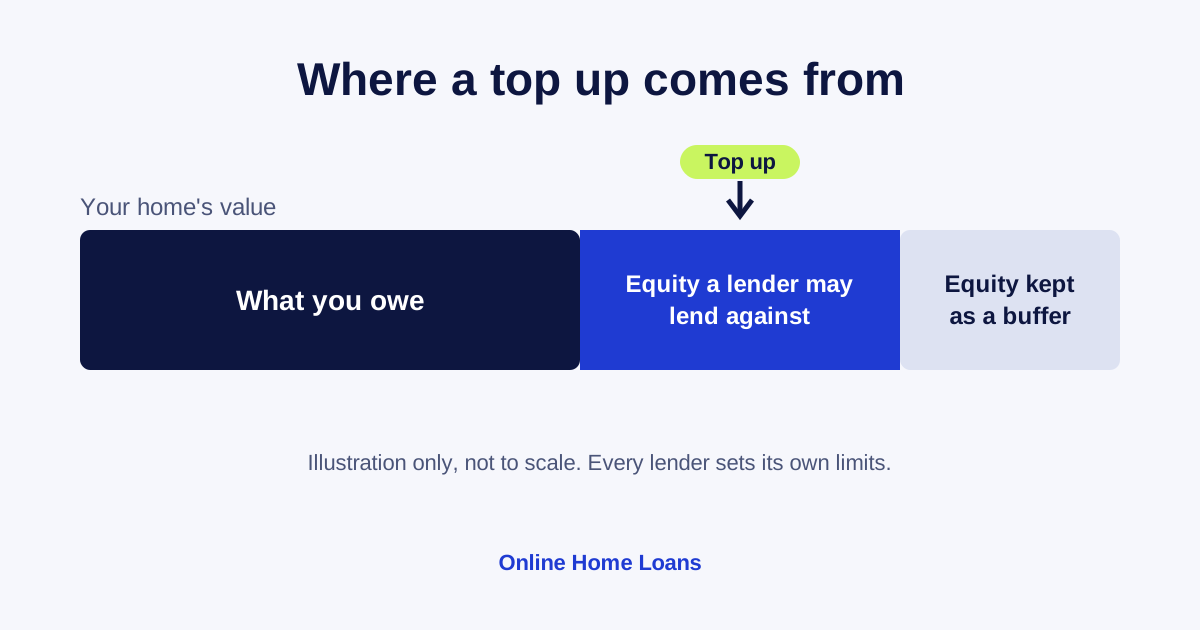
A home loan top up means borrowing extra on your existing mortgage, usually with the lender you already have, using the equity in your home as security. A top up is a common way to fund a renovation or a big repair. It's still new borrowing, though, so the lender looks at your situation again before deciding.
Key points
- A top up adds to your current home loan, and the extra is assessed much like a fresh application.
- How much might be possible depends on your equity, your income and what the money is for.
- Rates change often, so it's worth checking current rates rather than relying on an old figure.
- Spreading a renovation over a long loan term can mean more interest in total than paying it off faster.
How does a home loan top up work?
Equity is roughly what your home is worth minus what you owe on it. When you ask for a top up, the lender works out how much of that equity it is comfortable lending against, then checks whether your income can carry the bigger loan. The extra might be added to your existing loan, or set up as a separate portion with its own term and rate type, which can keep the renovation money easy to track.
When does a top up suit a renovation?
It tends to come up when the job is bigger than your savings, such as a new kitchen or bathroom, reroofing, or insulation and heating. Lenders usually want to see builder's quotes, and for larger work they may ask for a valuation. If the work is staged, it's worth asking how the money is released, as some lenders pay out in stages.
Tip Get your quotes sorted before you ask about a top up. A clear scope and a written quote speed things up and help you borrow what the job needs rather than a round number "just in case".
There's no credit check to enquire.
What do lenders usually look at?
Under New Zealand's responsible lending rules, lenders have to check that new borrowing is likely to be affordable and suits what you need it for. That usually means looking at:
- Your equity after the top up, meaning how much you'd owe compared with the home's value.
- Your income and spending, which lenders often test at their own assessment rate, usually a bit higher than the rate you'd actually pay.
- What the money is for, since a renovation and paying off other debts are looked at differently.
- Your credit history, including any recent missed payments.
Top up, cash out or refinance: what's the difference?
A top up is usually arranged with your current lender, while cashing out equity as part of a refinance means moving lenders and increasing the loan at the same time, which brings legal work and possibly break costs if you're part way through a fixed term. Our cash out equity guide covers that route, the cash out equity page explains the options, and the cash out equity calculator gives a rough starting figure.
Worth a look If you're reviewing your home loan anyway, our guide to refinancing explains how moving to a different lender works and the costs to weigh up, such as break fees if you're part way through a fixed term.
What's worth checking before you go ahead?
- Your fixed rate, including how long is left and how a top up fits around it, and if it's ending soon our guide to getting a lower home loan rate is worth a look.
- The new repayment on the bigger loan, at the term you choose.
- Total interest if the cost is spread over many years.
- Any costs, such as fees for the new lending or a valuation.
If you'd like to understand what a top up could look like for your home, we can put you in touch with someone who can talk through your options, with no obligation.
Home loan top up FAQs
Can I top up my home loan if I'm on a fixed rate?
Often, yes, because the extra is commonly set up as a separate portion and your existing fixed portion can stay as it is, but your lender will confirm how it would work for your loan.
How long does a top up take?
It varies between lenders and depends on whether a valuation is needed. Having your quotes, recent payslips and bank statements ready usually helps things along.
Will a top up change my repayments?
Usually, yes. Borrowing more generally means higher repayments unless the term is stretched, and a longer term can add to the total interest you pay.
Is a top up the same as a reverse mortgage?
No. A top up is borrowing you repay on agreed terms while you own the home. A reverse mortgage is a separate later-life product with its own rules.
Sources (checked 19 Oct 2026)
- Consumer Protection (MBIE), What lenders must do: lenders must check affordability and suitability, including what the loan is for.
- Sorted (Retirement Commission), How much of a mortgage you could get
General information only, not advice. We're a referral service. Mortgage advisers are usually paid a commission by the lender. If your loan settles, the adviser's business may pay Online Home Loans a referral fee. It is not added to your loan and does not change what you pay.