Mortgage break fees in NZ: how they're worked out and when to ask your lender
(updated )3 min read
Leaving a fixed rate home loan early can mean a break fee. Here's how break fees usually work in NZ, why they change and what to ask your lender first.
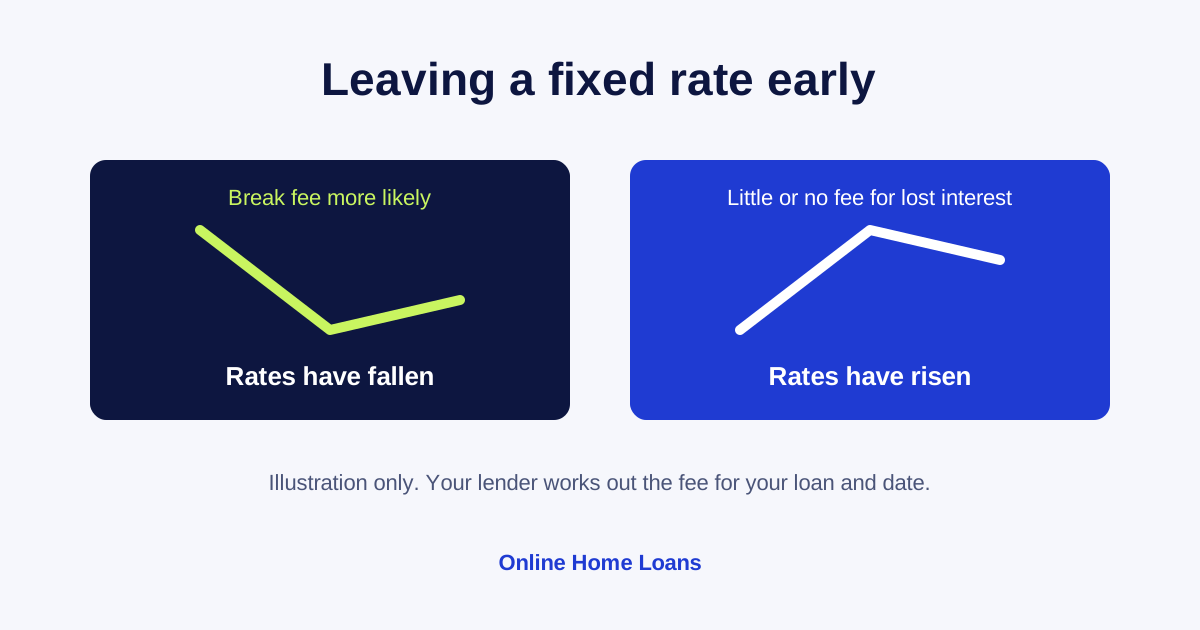
A break fee is what a lender may charge if you leave a fixed rate home loan before the fixed term ends, whether that's paying it off, refinancing to another lender or moving to a new rate early. It's there to cover the lender's loss from you leaving early, so the amount depends on your loan and on what interest rates have done since you fixed. That's why the number can be tiny one month and a lot bigger the next.
Key points
- A break fee only applies if you leave a fixed term early, and it has to be set out in your loan contract.
- On consumer home loans, lenders can't profit from break fees. The fee has to be a reasonable estimate of the lender's loss.
- The fee usually depends on rate movements, so it's often bigger when rates have fallen since you fixed.
- Quotes change over time, so ask for one for your loan and the date you have in mind.
How are break fees worked out?
When you fix, the lender lines up its own funding on the expectation that you'll pay that rate for the whole term. If you leave early and rates have since dropped, it can't relend the money at the rate you were paying, and the break fee is meant to cover that gap. For consumer home loans, the Credit Contracts and Consumer Finance Act says the fee must be a reasonable estimate of the lender's loss, worked out either with a method set out in regulations or another appropriate method written in your contract. On top of that there may be an admin fee.
When might there be little or no break fee?
If market rates have gone up since you fixed, the lender generally isn't losing money on your loan, so the fee for lost interest is usually small or nil, though an admin fee may still apply. There's also normally no break fee when your fixed term simply ends and you refix or move then. Some loans also let you make extra repayments during a fixed term without a fee, so it's worth checking your contract or asking the lender what yours allows.
Tip Ask your lender for a written break fee quote for your loan and the exact date you're thinking of. Quotes can move as interest rates change, so an old figure, or a mate's, won't tell you much.
There's no credit check to enquire.
When is it worth asking about a break fee?
- You've spotted a lower rate elsewhere and want to know if switching early still stacks up.
- You're selling and won't be taking the loan with you to the next place.
- You want to pay down a big lump sum, such as an inheritance or the sale of another property.
- You're restructuring your loan, for example splitting it or moving part of it to floating.
Is breaking early worth it?
It can be, but it depends on the numbers. The usual way to look at it is to compare the break fee and any switching costs, such as legal fees or a cashback clawback, against the interest you'd save over the rest of the fixed term. Our refix vs refinance calculator gives a rough net figure, and our guide to refinance costs lists the other costs to weigh up.
Worth a look If your fixed term ends in the next few months, waiting until it does can be the simplest way to avoid a break fee. Our refinance page explains how moving to a different lender works.
If you'd like help working out whether moving now or waiting makes more sense, we can put you in touch with someone who can talk through your options, with no obligation.
Break fee FAQs
Can my lender charge whatever break fee it likes?
No. For consumer home loans, the fee has to be a reasonable estimate of the lender's loss and lenders can't use it to make a profit. If you think yours has been worked out wrongly, complain to the lender first, then to its disputes resolution scheme if you can't agree.
Can I make extra repayments without a break fee?
Sometimes, up to a limit. Some fixed loans allow extra repayments each year without a fee, and the limit varies, so check your contract or ask your lender.
Why did my break fee quote change?
Because it usually tracks interest rate movements. If rates shift between one quote and the next, the fee can move too, which is why a fresh quote close to the date matters.
Can I avoid a break fee if I'm selling?
Sometimes. Some lenders let you carry your loan across to the next home, which can mean no break fee. Your lender will confirm what's possible for your loan.
Sources (checked 27 Oct 2026)
- Consumer Protection (MBIE), Mortgages and home loans: breaking a fixed term, when a break fee applies and how to complain.
- Consumer Protection (MBIE), Unfair fees: break fees must be a reasonable estimate of the lender's loss.
- Commerce Commission, Mortgage break fees investigation: how section 54 of the Credit Contracts and Consumer Finance Act applies.
General information only, not advice. We're a referral service. Mortgage advisers are usually paid a commission by the lender. If your loan settles, the adviser's business may pay Online Home Loans a referral fee. It is not added to your loan and does not change what you pay.