Fixed rate ending: floating, short fix, long fix and split loans explained
9 min read
Edited by Kyle Imeson
What floating, a shorter fix, a longer fix and a split loan mean when a fixed rate is ending, including flexibility and how certain the repayment is.
When a fixed home loan rate is coming to an end, the next choice is usually one of four shapes. You can let that part of the loan float, fix it again for a shorter term, fix it again for a longer term, or split the balance so more than one of those runs at once. Floating generally means the rate can move and extra repayments are easier. A fix holds the repayment steady for the term you agree, and ending that portion early can mean a break fee. A split is how people often keep some of the repayment steady and still leave room to pay extra. This page explains what each option means. It does not pick one, and it does not guess where rates are heading. Rates change often.
If you have been comparing a floating vs fixed mortgage in NZ, the same ideas cover a split and the length of the fix. A broker can talk through your options, and we do not set the rate or the term.
Key points
- Floating means the rate can move, usually with wider interest rates and the Official Cash Rate, so the repayment can rise or fall and extra payments are generally easier.
- A shorter fix locks the repayment for a shorter term, and then you choose again.
- A longer fix keeps that repayment steady for longer, and leaving it early can mean a break fee.
- A split puts portions on different rates, often some fixed and some floating, so the flexible part is where extra payments usually go.
How do floating, a short fix, a long fix and a split compare?
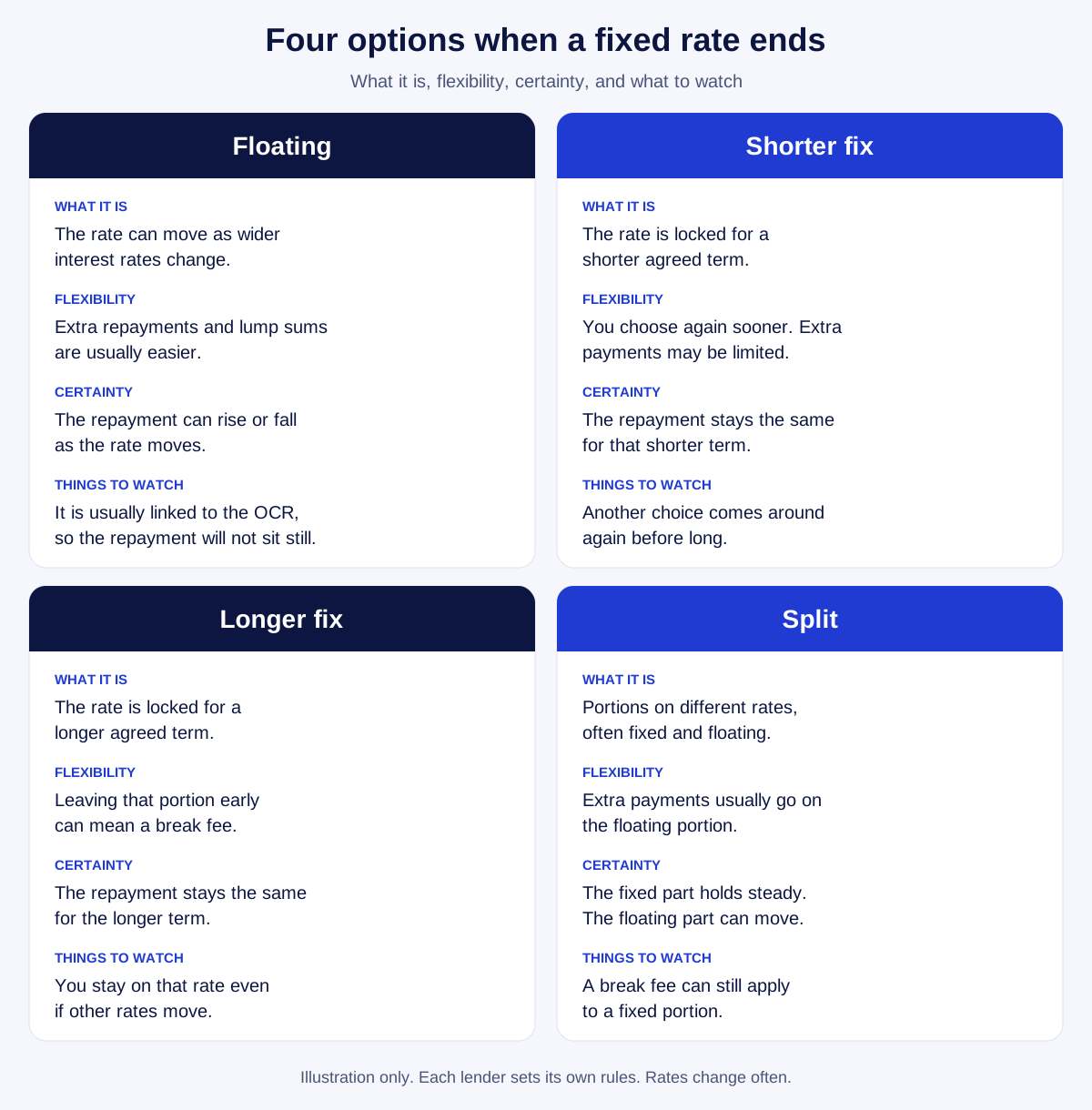
Sorted, the Retirement Commission's money guide, describes these as ways of setting the interest rate, not as a ranking. A fixed rate is locked for an agreed term, so the minimum repayment does not change during that term unless you break it. A floating rate (also called a variable rate) moves as wider interest rates change, usually linked to the Official Cash Rate, so the repayment can go up or down. You can also split a loan between fixed and floating. The public explanation of those structures is Sorted's types of mortgages guide.
What does a floating rate mean?
A floating rate is one the lender can move as interest rates in the wider market change. Sorted links that movement to the Official Cash Rate, and it says the repayment can go up and down because of it. The part a lot of people care about is flexibility. On a floating loan it is generally easier to make changes, including paying the loan off early or changing the term, without a penalty, and extra repayments on a floating portion do not attract the break fee you can meet on a fixed portion.
That flexibility has a trade-off you can feel in the budget. Because the rate can move, the repayment is not a number you can pencil in for years ahead. If wider rates rise, the repayment can rise with them, and if they fall, it can fall. This page does not say a floating rate sits higher or lower than a fixed one. The rate you are offered is the one to check, because rates change often.
When a fixed term simply ends and you do not choose another fix, Sorted notes that the loan normally moves onto a floating rate. That is a reason to look before the date, not a reason to assume the new repayment will be lighter or heavier. Your own lender's letter is the one that counts.
What does a shorter fixed term mean?
A shorter fixed term locks the interest rate, and the minimum repayment, for a shorter agreed period. You know what you will pay while that term runs. When it ends you choose again, whether that is another fix, floating, or a different split. People tend to look at a shorter term when they want the repayment to stay put for now, and they also want another decision fairly soon, for example because they might sell, pay a lump sum, or look again once the next rate card is out.
Those limits apply here too. Extra repayments and lump sums are often capped while the term runs, and ending it early can mean a break fee. A shorter term does not remove that. It means the lock lasts for less time, so the moment you can change without breaking the contract comes around sooner.
What does a longer fixed term mean?
A longer fixed term is the same kind of lock, held for longer. The repayment stays the same for that whole term, which is the certainty Sorted describes: you know how much each repayment will be until the term ends. People tend to look at a longer term when they want that number to stay put, and they are not planning to clear the loan or move house while the term still has a long way to run.
The things to watch sit on the other side of that certainty. Leaving early, whether you sell or you want a different rate before the term ends, can mean a break fee, and extra repayments may be limited. Because you are on the agreed rate for the whole term, you stay there even if other rates move. Sorted notes that a longer fix can leave you on your rate if floating rates later fall below it. That is a trade-off to understand, not a forecast, and it is not a reason on its own to pick a short term either.
How do people usually think about a split?
A split mortgage means the loan is divided into portions, and each portion can have its own rate and its own term. The version Sorted describes most often is part fixed and part floating. The fixed portion holds the repayment steady. The floating portion is where extra repayments and lump sums usually go, without the break fee that can apply if you overpay a fixed portion. How much you put in each portion, Sorted says, depends on whether certainty or flexibility matters more to you. Many people keep most of the loan fixed and some of it floating for that reason, so the steady repayment covers the bulk and the smaller piece is the one they can pay down faster.
Portions do not have to end on the same day. A shorter fix can sit beside a longer one, with or without a floating piece, and each portion follows its own rules. A break fee question is about the fixed portion you would end early, not automatically about the whole balance. If the loan is already split and you are wondering about moving some or all of it, the dates and the exit costs are a different job, covered in what to check before you switch a split loan.
What about extra repayments, lump sums and break fees?
On a fixed portion, Sorted says you can often lift the regular repayment a bit above the minimum without a penalty. The limit varies, so it is one to ask the lender about rather than copy from someone else's loan. A larger lump sum is a different step. Sorted describes paying that lump sum onto a floating portion, or just after a fixed term ends, so you are not charged for paying more than the fixed portion allows.
A break fee is the charge for ending a fixed-rate loan early, for example by repaying it in full or moving it before the term ends. Consumer Protection says you can break a fixed term, and that the lender can charge a fee to cover its costs or losses where the contract allows it, on top of an administration fee. Lenders cannot profit from that fee. It is more likely to matter when market rates have fallen since you fixed, because the lender cannot relend the money at the rate you were on. If market rates are higher than when you fixed, Consumer Protection says the lender cannot charge a break fee. An administration fee can still be part of ending the term early, so the figure to ask for is the full one, for your portion and your date.
A rough way to set a break fee next to the cost of moving, if that is the comparison you are making, is the refix vs refinance calculator. It is an estimate you can play with, not a quote.
Tip Before the fixed term ends, ask your lender what extra repayments and lump sums each portion allows, and for a written break fee figure if you would be ending a fixed portion early. The answer sits in your contract, and someone else's quote will not match your loan.
There's no credit check to enquire.
Is there a best fixed term?
People look up the best fixed term, and the public guides do not name one. A shorter fix and a longer fix are both a lock for an agreed time. Sorted's point on a split is that the mix depends on whether you want the repayment to stay put, room to pay extra, or some of both. Consumer Protection suggests thinking about your budget, whether the repayment might need to change, and how long you expect to be paying the loan, then talking it through with your lender or a broker. We do not choose a term, and we do not predict where rates go next.
If a lower rate is the reason you are looking, the comparison of an offer and the timing sit in a lower home loan rate and a fixed rate ending soon. Those pages are about the rollover. This one is only about what the options mean.
How do interest rates and the OCR fit in?
Home loan rates move often, and the Reserve Bank's Official Cash Rate is part of why. The OCR is the rate banks earn on deposits at the Reserve Bank, and it sets what banks pay to borrow from the Reserve Bank. When it changes, banks usually adjust the rates they charge customers, including on mortgages, though they do not pass it through as a single rule. The Reserve Bank says banks set their own rates using the risk of the loan, their costs, competition, the exchange rate, and where they think the OCR is heading. They can move a mortgage rate even when the OCR itself has not changed, because they plan ahead.
A floating rate is the one that can move while you are on it. A fixed rate stays as agreed until that term ends, which is also what the Reserve Bank says about fixed-rate loans. When the OCR goes up, mortgage rates often go up, and when it goes down, mortgage rates usually fall. That is a description of how the settings work, not a view on what happens next. Current numbers change, so they belong on the Reserve Bank's Official Cash Rate page, not copied into an article.
What is this page not trying to decide?
Staying with your lender and choosing a new rate is a different question from replacing the loan. The difference between those two paths is in refinance or refix, and the steps in a full move are on the refinance page. Nothing here says you should float, fix, split, stay, or move. If you would like a broker to talk through your own statements, you can get in touch, with no obligation to go ahead.
Floating and fixed FAQs
Can I split my home loan between fixed and floating?
Yes. Sorted says you can split a loan between a fixed rate and a floating rate. The fixed portion keeps the repayment steady for its term, and the floating portion is where extra repayments can usually go without a break fee. How much sits in each portion depends on whether certainty or flexibility matters more to you. A broker can talk that through for your loan. We do not set the split.
Is a shorter fixed term better than a longer one?
Neither one is named as better in the public guides. A shorter fix means you choose again sooner, and a longer fix keeps the repayment the same for longer. Ending a fixed portion early can mean a break fee. The useful question is how long you want the repayment to stay put, and whether you might need to change the loan before then.
Do I pay a break fee if I make a lump sum on a fixed portion?
You might, if the lump sum is more than your fixed portion allows. Sorted says a lump sum is often paid onto a floating portion, or just after a fixed term ends, so you avoid a penalty for paying too much while you are fixed. Some fixed loans let you lift the regular repayment a little without a fee. Ask your lender what your contract allows, and for a break fee figure, before you pay a large sum early.
Does a floating home loan rate move when the OCR changes?
It can. Sorted describes a floating rate as moving with wider interest rates, usually linked to the OCR, so the repayment can rise or fall. The Reserve Bank says banks usually adjust customer rates when the OCR changes, and that they also set rates using their own costs and competition, sometimes even when the OCR has not moved. A fixed rate does not change until its term ends. Rates change often, so check a current rate rather than an old one.
Sources (checked 17 Nov 2026)
- Sorted (Retirement Commission), Types of mortgages: a fixed rate is locked for an agreed term so the minimum repayment does not change unless you break it, a floating rate moves with wider rates and is usually linked to the OCR, you can split fixed and floating, extra repayments on the floating portion do not attract that charge, and a longer fix can leave you on your rate if floating rates later fall below it.
- Sorted (Retirement Commission), Managing a mortgage: many people keep most of the loan fixed and some floating, a fixed loan can often take a small extra repayment without a penalty, and a lump sum is often paid on the floating portion or just after a fixed term ends.
- Sorted (Retirement Commission), Shopping for a mortgage: a fixed-interest loan normally converts to a floating rate at the end of the term, and you can ask about taking another fixed term.
- Consumer Protection (MBIE), Mortgages and home loans: interest can be fixed, floating or a combination. Ending a fixed term early can mean a fee to cover the lender's costs or losses, on top of an administration fee. Lenders cannot profit from break fees. If market rates have fallen, the lender may be covering a loss, and if rates are higher than when you fixed, it cannot charge a break fee.
- Reserve Bank of New Zealand, The official cash rate: the OCR influences mortgage rates, banks set their own rates, fixed-rate loans do not change until the term ends, and mortgage rates often move when the OCR changes. The Reserve Bank page was last updated 28 October 2026. The rate itself changes, so it is not copied here.
General information only, not advice. We're a referral service. Mortgage brokers are usually paid a commission by the lender. If your loan settles, the broker's business may pay Online Home Loans a referral fee. It is not added to your loan and does not change what you pay.